
Klima Global General Trading LLC
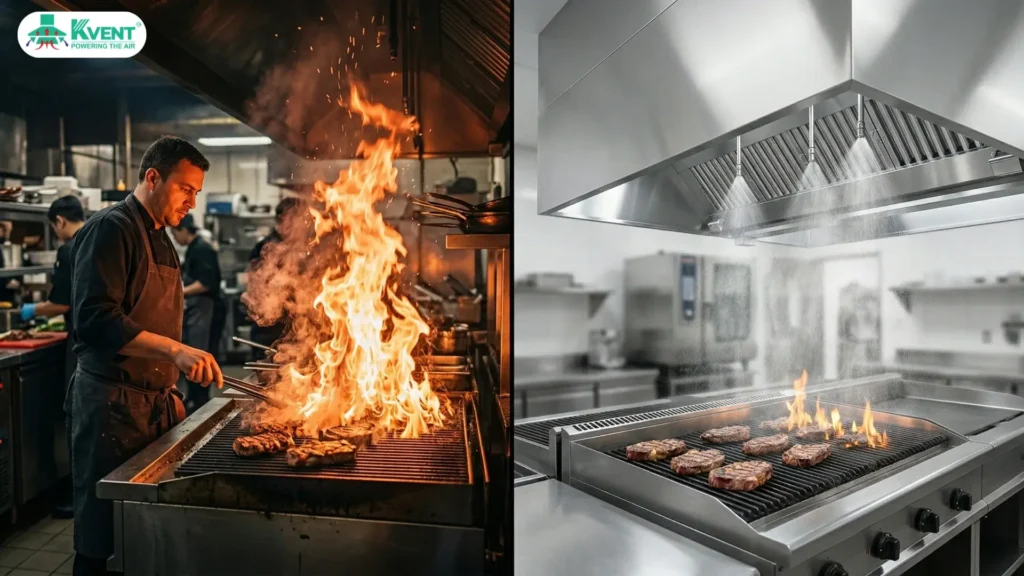
Imagine your restaurant on a bustling Friday night in Dubai. The dining room is packed, tickets are printing relentlessly, and the kitchen is humming.
Suddenly, it all comes to a terrifying halt. This disaster doesn’t start from a culinary mistake on the line, but rather from a catastrophic hazard igniting entirely out of sight.
For restaurant owners and facility managers in the GCC, a sudden fire is the ultimate nightmare. It threatens human life, destroys property, and causes total business interruption.
Understanding the root cause is the first critical step in commercial kitchen fire prevention. The most chilling fact is that these fires rarely start in the open; they begin in the dark, hidden spaces of your exhaust ductwork.
The anatomy of a disaster begins right above your high-intensity cooking surfaces. Heavy-duty cooking—especially charbroiling, wok cooking, and deep-frying—vaporizes grease at a rapid rate.
If your kitchen relies on basic, outdated, or poorly maintained mesh filters, microscopic grease vapors simply bypass the primary filtration system. You might wipe down your stainless steel canopy every night, but a false sense of security is building above.
For deeper insights on the risks of inadequate equipment, read our guide on The True Cost of a Restaurant Fire: Why Cheap Hoods Cost You Everything.
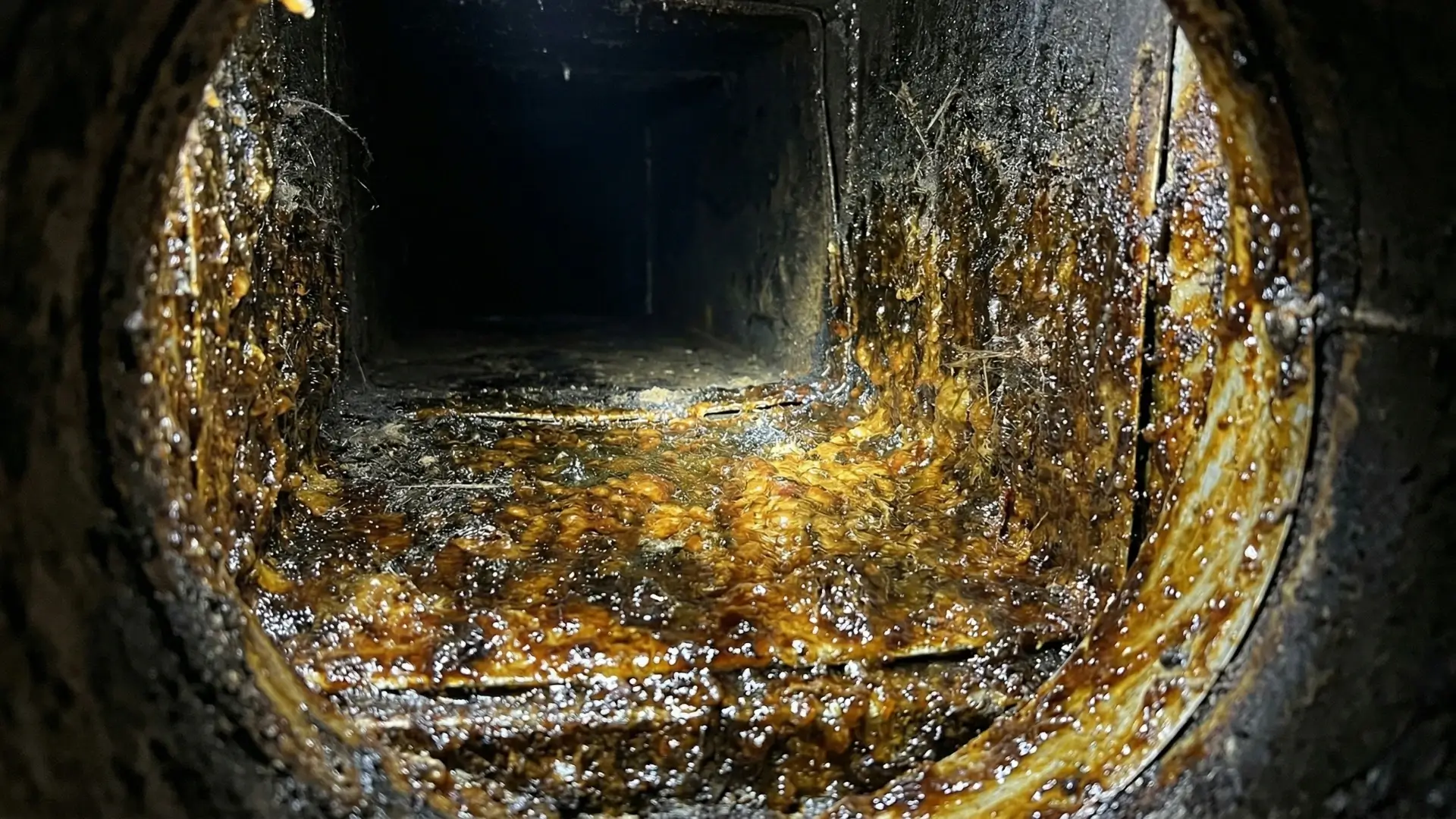
As that hot, grease-laden air is pulled up into the exhaust ductwork, it begins to cool. When vaporized grease cools, it changes state.
It solidifies into a sticky, highly combustible resin that aggressively coats the interior walls of your ducts. Day after day, this highly flammable fuel source grows thicker.
Because it is completely hidden from view, kitchen staff operate beneath a ticking time bomb. This is where proactive commercial kitchen fire prevention becomes a matter of business survival.
All it takes is a single catalyst to turn this accumulated resin into an inferno. A sudden flare-up from a dropped burger patty on the charbroiler sends a stray spark upward into the hood.
Without proper suppression, that spark travels directly into the plenum, reaching the flashpoint instantly. Once the grease inside the duct ignites, the exhaust fan acts like a blacksmith’s bellows.
It feeds massive amounts of oxygen directly into the flames, creating a dangerous “chimney effect.” The fire races up the ductwork at terrifying speeds, often engulfing the building’s roof in minutes.
At Klima Global, we know standard ventilation isn’t enough to protect high-volume commercial kitchens in the MENA region.
The KVENT line of hoods and scrubbers is specifically engineered to interrupt this anatomy of a fire at every single phase. We engineer fire out of the equation.
KVENT High-Performance Baffle Filters
The first line of defense utilizes our advanced, UL/VDI certified baffle filters. Built from premium AISI 304/316 stainless steel, they force air into rapid directional changes.
This aerodynamic design physically throws heavy grease particles out of the airstream and into safe collection troughs. The grease is trapped before it ever reaches the dangerous ductwork zones.
KVENT Water Mist Hoods: Spark Abatement
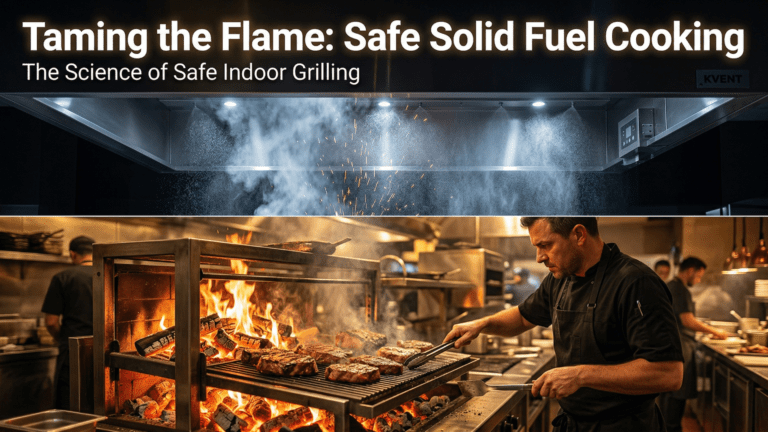
For high-risk environments involving solid fuel or heavy charbroiling, standard filters are not enough. The KVENT Water Mist Hood is your absolute safeguard.
It utilizes a continuous spray of high-pressure cold water mist inside the exhaust plenum. If a spark flies up from the grill, it is instantly neutralized by the water barrier.
Furthermore, the cold mist drastically drops the temperature of the exhaust air. To understand more about this specialized equipment, check out our article on Solid Fuel Cooking: Why Wood & Charcoal Grills Demand Water Mist Hoods.
Aquafil Wet Scrubber: The Ultimate Tool for Commercial Kitchen Fire Prevention
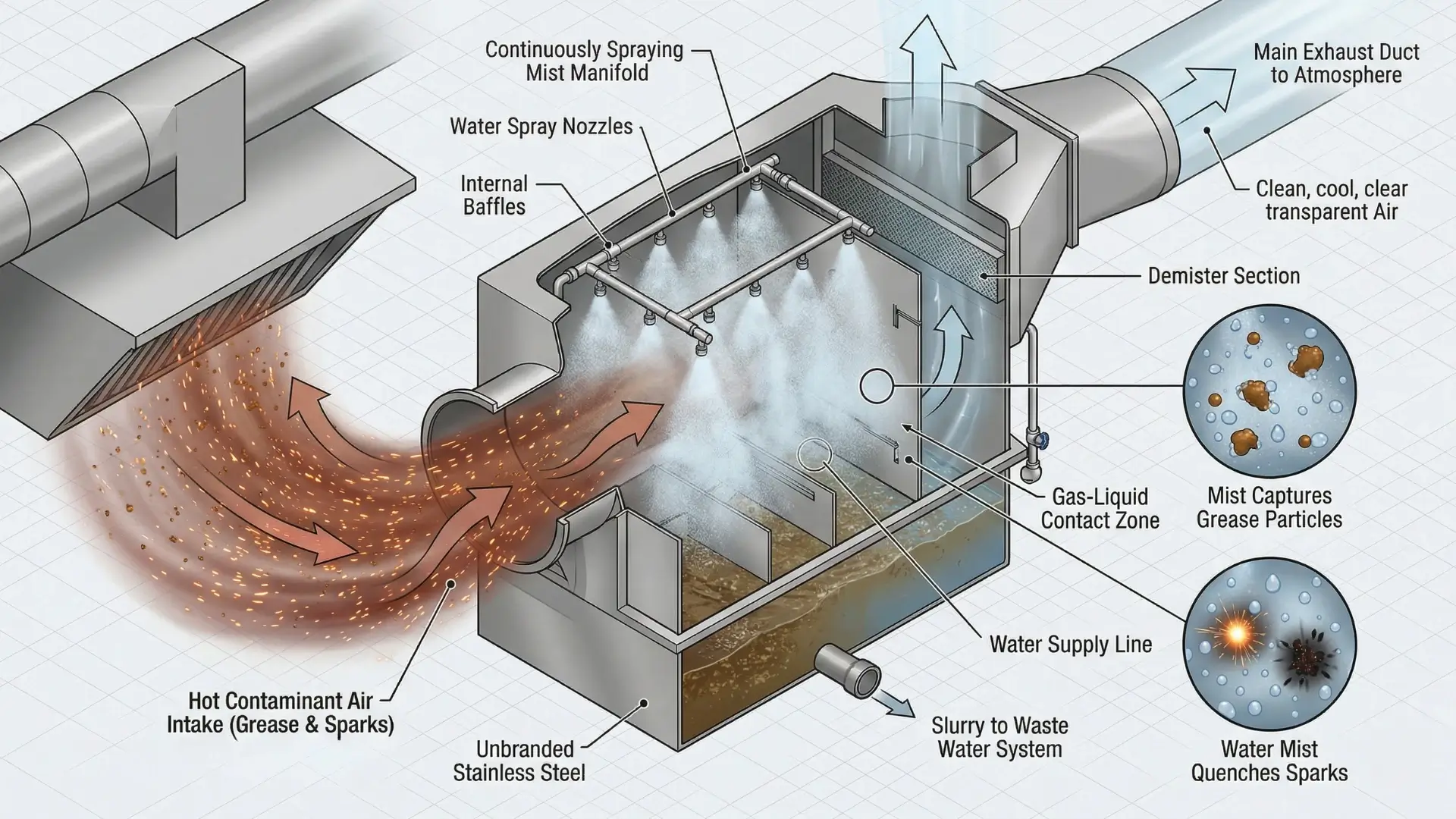
To virtually eliminate duct buildup, the Aquafil Wet Scrubber sits inline to treat the exhaust air before it hits the main duct system.
Using continuous water-based adiabatic filtration, the Aquafil captures an astonishing 98% of grease and vapor particles.
By scrubbing the air clean and capturing the fuel source, it ensures your ductwork remains clean, safe, and fully compliant with NFPA 96 standards.
Kitchens in Dubai, Abu Dhabi, and across the GCC operate in extreme ambient temperatures and handle massive volumes of food production.
This requires robust, industrial-grade equipment. Klima Global engineers systems precisely for these demanding environments, ensuring compliance with strict municipal codes.
Learn more about local regulations in our guide to NFPA 96 Compliance in the MENA Region: Is Your Kitchen Legal?.
Feature | KVENT Water Mist Hood | Aquafil Wet Scrubber |
Primary Function | Spark abatement & exhaust cooling | 98% grease & vapor capture |
Material Build | AISI 304/316 Stainless Steel | AISI 304 (316L available) |
Fire Safety Standard | NFPA 96, CE, UL Listed | NFPA 96 compatible, ASHRAE 52 |
Lighting Integration | IP65 LED, Fire-rated (up to 150°C) | N/A (Inline duct system) |
Ideal Application | Open flames, grills, tandoors | High-volume kitchens, food courts |
Beyond safety, upgrading your ventilation systems can drastically lower your facility’s operational risks. Find out Why Your Insurance Premiums Are Skyrocketing and how Klima Global can help bring them down.
Curious about the technical mechanics? Dive into The Science of Air Scrubbing: How Water Cleans Commercial Kitchen Exhaust.

Your message has been sent successfully.
Our team at Klima Global will get back to you shortly.
If you’d like to reach out directly:
📞 +971 52 277 4852
📧 info@klimaglobal.com
💬 Chat with Us on WhatsApp
In the meantime, feel free to explore: