Destroying Grease at the Molecular Level: The Science of UV Kitchen Exhaust Systems
The traditional approach to commercial kitchen exhaust maintenance is fundamentally flawed. Facility managers allow highly flammable grease to build up in dark ductwork, only to later pay an expensive, specialized cleaning crew to manually scrape it out.
This reactive cycle causes severe facility downtime, incurs massive recurring operational costs, and leaves the building vulnerable to fire hazards in between cleaning cycles.
For modern, high-volume GCC facilities, engineers are turning to a permanent, molecular solution. UV-C technology isn’t just an equipment upgrade; it is a paradigm shift in how we manage UV kitchen exhaust systems.
By utilizing the science of photolysis and ozonolysis, the KVENT UV Hood by Klima Global destroys grease before it can ever accumulate.
The Failure of Passive Filtration
To understand the necessity of advanced technology, we must acknowledge the limitations of passive filtration.
Even the best premium baffle filters—like KVENT’s primary aerodynamic extraction system—are designed primarily to capture large, liquid grease droplets. They are highly effective at this first stage.
However, high-intensity commercial cooking produces microscopic, vaporized organic compounds and aromatic molecules. These vapors easily bypass physical filters. They enter the ductwork where they eventually cool, condense, and form the sticky, flammable resin that plagues facility managers.
This condensation is the exact reason why manual duct scraping is required. Advanced UV kitchen exhaust systems attack the grease that physical filters cannot catch.
Destroying Grease: The Science of Photolysis
The KVENT UV Hood engineers the problem out of existence using high-intensity ultraviolet lamps located directly inside the exhaust plenum.
These specialized lamps emit energy at a precise 254 nm wavelength. When this intense UV-C light hits the vaporized grease molecules bypassing the primary filter, a process called photolysis occurs.
The intense energy of the 254 nm wavelength physically breaks the long-chain molecular bonds of the organic grease compounds. The sticky, complex grease molecule is shattered into smaller, non-stick, and non-combustible fragments.
The Secondary Attack: Ozonolysis and Odor Control
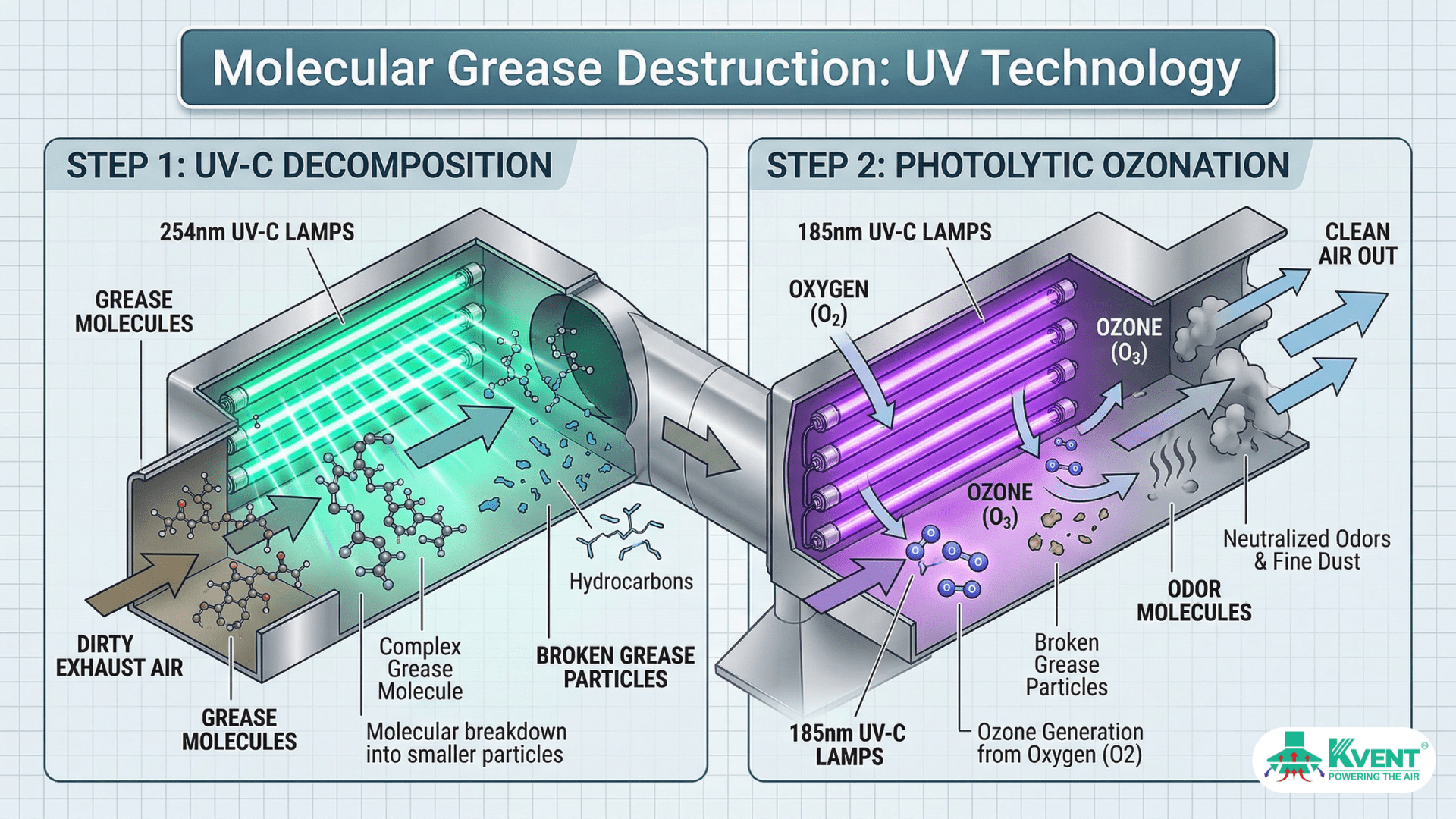
The KVENT UV lamps also emit a second, highly critical wavelength at 185 nm. This specific wavelength interacts with the oxygen (O₂) naturally present in the exhaust air to create Ozone (O₃).
Ozone is a highly reactive oxidizer. Through a process called ozonolysis, this ozone attacks and oxidizes the freshly broken-down grease fragments from the photolysis stage.
Crucially, it also neutralizes the volatile organic compounds (VOCs) responsible for harsh cooking odors. The end product of this dual-wavelength reaction converts the sticky grease into harmless carbon dioxide (CO₂), water vapor (H₂O), and a fine, dry powder that safely blows out of the exhaust fan.
The ROI: Ending the Duct Cleaning Cycle
Translating this science into financial operational savings is where UV kitchen exhaust systems prove their value. Because the grease is literally destroyed in the airstream, it never has the opportunity to condense on your duct walls.
A KVENT UV Hood can extend the interval between required professional duct cleanings by up to 80% to 90%.
For 24/7 hotel operations, bustling airports, and high-volume food courts in Dubai and Riyadh, eliminating maintenance downtime is invaluable. The ROI on a UV system is typically realized within the first year of operation through the sheer reduction of manual cleaning costs.
For a broader look at reducing facility costs, read our guide on Why Your Insurance Premiums Are Skyrocketing.
Seamless Integration and Safety
Dealing with UV-C light and ozone requires precise engineering safety standards. KVENT UV Hoods are built from premium AISI 304/316 stainless steel to withstand the oxidative environment.
More importantly, they feature strict mechanical and magnetic safety interlocks. If a primary baffle filter is removed or the hood door is opened by kitchen staff, the UV lamps instantly shut off, ensuring zero exposure to the kitchen brigade.
For the ultimate “Smart Kitchen” setup, facility engineers often pair KVENT UV Hoods with our advanced Demand Control Ventilation (DCV) technology to maximize both absolute hygiene and extreme energy efficiency.
Frequently Asked Questions About UV Kitchen Exhaust Systems
- How do UV kitchen exhaust systems destroy grease?
They use specialized UV-C lamps emitting at 254 nm and 185 nm. The light breaks the molecular bonds of the grease (photolysis) and creates ozone to oxidize the remaining fragments and odors (ozonolysis). - Will I still need to hire duct cleaners if I install a UV hood?
Yes, but significantly less often. A KVENT UV system destroys vaporized grease before it enters the ductwork, which can extend the time between required professional duct cleanings by up to 90%. - Is the UV-C light dangerous to kitchen staff?
No. The UV lamps are housed safely inside the enclosed exhaust plenum. KVENT hoods are equipped with strict safety interlocks that instantly cut power to the lamps if the filters are removed or accessed. - Do UV kitchen exhaust systems eliminate cooking odors?
Yes. The 185 nm wavelength generates ozone, which is a powerful oxidizer. This process neutralizes the volatile organic compounds (VOCs) that cause harsh cooking odors, saving facilities from neighbor complaints. - Are KVENT UV Hoods compliant with GCC regulations?
Yes. KVENT systems are built to stringent international standards (NFPA 96, CE, UL Listed) and are fully compliant with UAE Civil Defence and Saudi Building Code requirements for commercial ventilation.
Upgrade Your Facility’s Engineering Standard
Stop paying to clean the symptoms of a poorly designed exhaust system. Eliminate the root cause of grease buildup at the molecular level.
By upgrading to KVENT technology, facility managers can ensure pristine ductwork, minimize fire risks, and drastically reduce operational downtime.
Ready to eliminate manual duct cleaning from your budget? Klima Global provides advanced KVENT UV Hoods engineered for the GCC’s most demanding facilities. Contact Klima Global Today to Consult with an Engineer